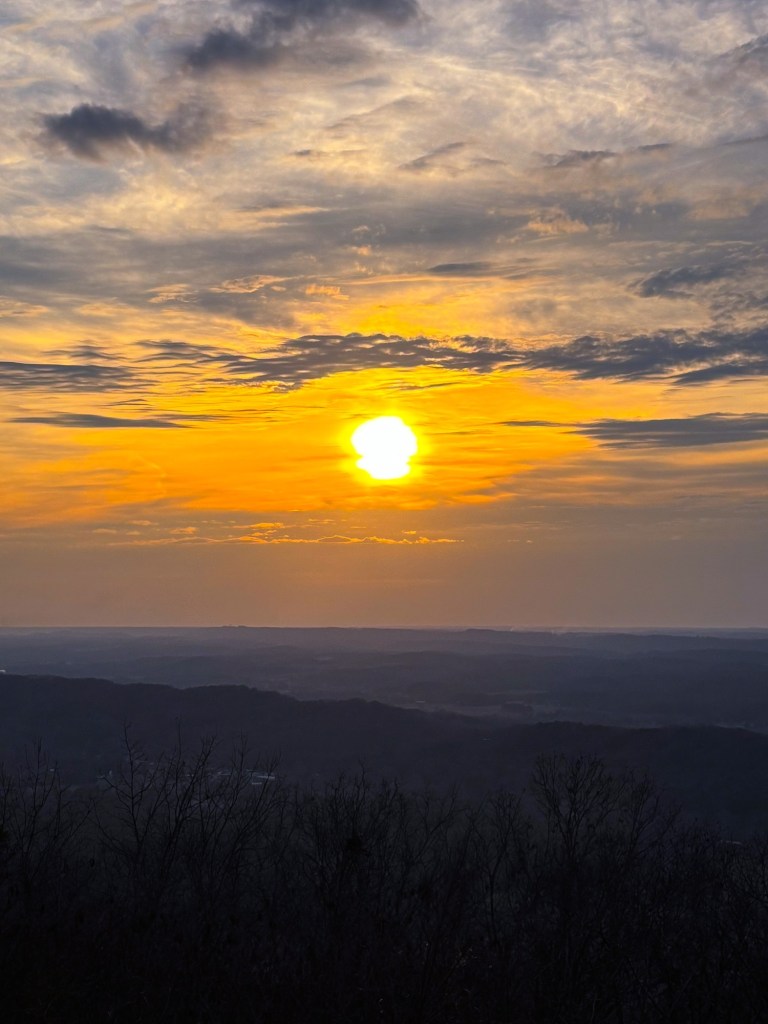
The sky looks different because you’re closer to eternity than the rest of us are right now. The veil between heaven and earth has grown thinner, and you can see it. The sky has shifted from being a backdrop to a promise.
The sky looks different because suddenly you’re seeing it without distraction. The ever-changing color palette of God. The timeless movement from light to dark. All the things we rush past. The sky hasn’t changed. You have.
The sky looks different because you see God. His creation. His invitation. Something you’ve always believed is now drawing very near.
The sky looks different because you’re almost home.
I’m up in the middle of the night, unable to sleep, so I turned to prayer. If I’m being very raw and honest here, many of my prayers lately have been me asking the Lord questions like, “Why?”
I can have unshakeable faith and trust in the Lord, but still question why I feel a certain way, why certain things happen, and why some things feel as if they will never change.
I’m reminded of Matthew 23:12—“And whoever exalts himself will be humbled, and he who humbles himself will be exalted.” I’ve been walking in humility, and then wondering why I don’t feel as if the Lord is lifting me up like His Word promises.
And then suddenly, the Lord brought me to 1 Peter 5:6—“Therefore humble yourselves under the mighty hand of God, that He may exalt you in due time.” He answered me through that verse, gently nudging me that it’s just not time yet. The NKJV says that He will lift me up in due time. Other versions say things like: at the right time, at the proper time, at the appropriate time, in His own good time, when the time comes.
So, a crying prayer of “why” turned into a promise of His perfect timing—a reminder to be more patient. Thank you, Lord.
When grief arrives before goodbye, it’s as if your heart has suddenly become frozen in time. Every memory comes flooding back all at once, the ones you treasure and the ones you’ve tried to bury. Every bit of hurt and resentment forces its way to the surface, yet boundless love and appreciation begin to rise above it all. You’re left not knowing how to gather a lifetime into final words, how to speak the things you’ve held inside for so long. Maybe some goodbyes from this world are meant to be felt more than spoken, for now.
“He heals the brokenhearted and binds up their wounds.” Psalms 147:3 (NKJV)
There was a girl who stood just outside the circle.
Like a puzzle piece cut wrong that never quite fit. Like a bookmark in a book no one plans to finish. Like a name written in pencil that is easy to erase. Like an extra chair left empty at a full table.
There was a girl who didn’t blend in easily, and she finally stopped pretending to. Because she didn’t need to anymore.
This girl was graced by the presence of God during her quietest moments. This girl felt the Holy Spirit when she couldn’t feel anything else.
This girl was given passions and purpose. This girl was given a strength and a confidence she had never known before. This girl was given a sense of peace and joy she couldn’t understand.
This girl received so much love. This girl discovered her life. This girl met Jesus.
There was a girl who stood just outside the circle. Because she realized she had never belonged in it. She belonged with God.
Picture taken by me at Great Smoky Mountains National Park in Gatlinburg, Tennessee
“But the Holy Spirit produces this kind of fruit in our lives: love, joy, peace, patience, kindness, goodness, faithfulness, gentleness, and self-control. There is no law against these things! Those who belong to Christ Jesus have nailed the passions and desires of their sinful nature to His cross and crucified them there. Since we are living by the Spirit, let us follow the Spirit’s leading in every part of our lives.” Galatians 5:22-25 (NLT)
Picture taken by me at Schacht Groves in Vero Beach, FL
Something that really stood out to me, and left a lasting impact, was watching the hawks as I peered down into the canyon from the overlooks above. It was remarkable to see things the way they do, to take in their size, their beauty, and the quiet assurance in the way they moved. I remember pulling into the small parking areas at each overlook and spotting these majestic birds perched on the ledges. But as soon as we stepped out of the car and moved closer, they lifted off and seemed to disappear down into the canyon.
When I reached the edge, though, I realized that they hadn’t gone very far at all. They were just riding the wind—gliding without even moving their wings, letting the air carry them above the canyon. They used the air to soar so effortlessly.
It brought my mind straight to the beautiful metaphor in Isaiah 40:31 (NLT): “But those who trust in the Lord will find new strength. They will soar high on wings like eagles. They will run and not grow weary. They will walk and not faint.”
These hawks were so confident in the air to carry them, to be their strength. They weren’t flapping their wings or trying to take control of things themselves. Their strength came simply from trusting in the air. And in the same way, we are called to trust in the Lord, to let His power carry us and lift us above the challenges of this life. If the hawks can surrender to the unseen air beneath them, surely we can surrender to the One whose strength is so much greater than our own.
Picture taken by me of Little River Canyon from an overlook in Fort Payne, AL
Being on top of a mountain, looking out over the valley below, had me thinking deeply about the goodness of God. Being up there felt triumphant—like standing in a place I wasn’t sure I’d ever reach. As I looked down at the valley, it felt like I was seeing the story of how far God has brought me. Every bump, every bend, every twisting road, every giant rock and fallen tree reminded me of the obstacles I’ve faced while climbing the mountain of life.
I kept thinking about Jesus.
I pictured Him standing on the mountain, preaching to His disciples, teaching the truths that still echo throughout the valley today. I thought about Him moving mountains—not in the physical sense, but the ones inside us: fear, anxiety, depression, doubt, heartbreak, sin, discouragement. It reminded me that the same Jesus who stood on the mountain then is still leveling the ones in my soul now.
In contrast, standing in the valley below and looking up at the mountain felt like seeing the distance I still have to go—the climb ahead of me, the places where God is still shaping me, and the hope of the view that waits at the top. It reminded me that these seasons are always temporary. The pathway back to the top is forever there, with Jesus as our constant and steady guide.
Life continually pulls us between the mountain and the valley, doesn’t it? Yet Jesus remains faithful through it all. He guides our steps whether we’re soaring above or struggling below. Each time we lose our footing, His hand reaches out to support us. He is with us in every rise, every fall, and every moment in between. With Jesus by our side, the valley becomes a place of growth, and the mountain a vantage point to see just how far His grace has carried us.
Picture taken by me at Brow Park on top of Lookout Mountain in Mentone, AL
I took this picture during a recent nature walk, and it stands out to me every time I see it in my camera roll. This lonely bench looks so inviting, and it screams such a loud message—as though it’s saying, please come take a seat, rest, pray, cry, breathe, let it all out. It reminds me of how sacred solitude is.
I can’t help but think of Jesus every time I look at it. I think about when He would retreat into the wilderness to spend time with God. He slipped away from the crowds—not to hide, but to silence the noise so He could hear God more clearly.
“But Jesus often withdrew to lonely places and prayed.” Luke 5:16 (NIV)
This lonely bench tells such a story. It tells us that the world often distracts us from God. It tells us that sometimes our battles need to be fought privately. It tells us that often the quietest places are where we hear God the loudest. Sometimes the most powerful thing we can do is simply be still before the Lord.
“Our hearts ache, but we always have joy. We are poor, but we give spiritual riches to others. We own nothing, and yet we have everything.” 2 Corinthians 6:10 (NLT)
Paul wrote this as part of a letter to the church in Corinth, where some members mocked him for his suffering, viewing his weakness as a sign that he wasn’t truly sent by God. In response, Paul wrote not only to defend his ministry but also to reveal the true nature of serving the Lord. His letter offers both a defense of his calling and a glimpse into the spiritual riches that come from walking with Christ, even in the hardest seasons. Faith has nothing to do with power, success, or wealth, but everything to do with humility, endurance, and sacrifice. It’s about having strong and genuine faith through suffering.
OUR HEARTS ACHE, BUT WE ALWAYS HAVE JOY:
Paul’s heart ached from rejection, persecution, loneliness, and the burdens of his ministry. Yet he never pretended that faith would erase those struggles. In the same way, our hearts ache for many reasons, but amid pain and tears, a deep joy runs beneath our circumstances—the kind of joy only Christ can give. It’s like holding sorrow in one hand and joy in the other—realizing they can coexist when Jesus is at the center. True joy comes from the presence of Jesus, not from the mere absence of sorrow.
WE ARE POOR, BUT WE GIVE SPIRITUAL RICHES TO OTHERS:
Paul lived humbly. He was not wealthy and had little to give in terms of material things, but he offered something infinitely more valuable—the light of the gospel of Jesus Christ. Even if your pockets are empty, you can still pour out something immeasurably greater than money: things like truth, wisdom, comfort, and encouragement—treasures that can’t be bought. Spiritual wealth has nothing to do with money. You can have nothing and still touch countless lives in meaningful ways through Christ.
WE OWN NOTHING, AND YET WE HAVE EVERYTHING:
Paul may not have had many possessions, but he knew that through Christ, he lacked nothing. The same is true for us. The forgiveness, love, peace, purpose, and promises we receive from Christ satisfy the human soul in a way nothing else can. In God’s economy, having Him means having everything. Jesus is our treasure—in this life and for all eternity. There is such profound richness in Him. He is all we need. He is enough. With Him, even when we have nothing, we still have everything.
I often picture a vivid scene in my mind. The imagery is intense. There’s a raging storm near a lonely shore. It’s dark and bitterly cold. Barren trees cling to the ground, fighting for life against the wind. Branches snap, and debris whirls dangerously through the air. Rain lashes sideways—the kind that would sting your face if caught in the crossfire. The wind howls, nearly drowning out every other sound. It’s deafening. Everything around is moving, shifting, breaking apart.
But right in the middle of it all stands a great rock—so solid, so still. It’s the only thing in sight that doesn’t tremble beneath the storm’s great fury. No force of nature could make it waver, not even slightly. It’s almost as if the storm stops when you look at this rock—like suddenly everything moves in slow motion, and all you can hear is a faint ringing in your ears. The more you focus on the rock, the quieter it gets. The calmer it becomes. The better you feel.
That rock is Jesus. That storm is my life.
Picture taken by me at Camp Hero State Park in Montauk, NY
You’ve hit it hard—headfirst into something you can’t move past. No doors. No windows. No way through. Just cold, unyielding stone staring back at you. You can’t turn around, and forward is impossible. The air grows thin as the wall seems to draw closer and closer. You’re trapped—ensnared, smothered, stagnant. It crowds you until you can barely breathe anymore. You’ve tried everything, but nothing moves. And now, you just want to quit.
But when there’s no way forward, look up. When there’s no path in front of you, maybe that’s because God wants you to lift your eyes up to Him. Sometimes no way forward means that you have to redirect your gaze—from struggling horizontally to surrendering vertically.
“I lift up my eyes to the hills. From where does my help come? My help comes from the Lord, who made heaven and earth.” Psalm 121:1-2 (ESV)
Picture taken by me of The Great Cross in Saint Augustine, FL
Life has a way of breaking us. Sometimes it happens suddenly; other times, it starts as a small crack that slowly deepens until it finally gives way. The plans we made, the dreams we hoped for, the people we trusted—broken, leaving us gasping for air in the wreckage. But when our hearts shatter, the presence of the Lord surrounds us and begins to gently pick up the pieces.
“The Lord is close to the brokenhearted; He rescues those whose spirits are crushed.” Psalm 34:18 (NLT)
God doesn’t wait for us to pull ourselves together; rather, He meets us right in the middle of the mess. Right where all the pieces have fallen. He handles them with such care, like slowly gathering small shards of glass one by one. None of the pieces ever go to waste—they’re all part of the story that He is continuously writing for us. He collects what pain has stolen and broken apart, and He graciously restores and rebuilds it.
The Lord is very near to us when we are broken. He takes a crushed spirit and breathes life back into it. Each broken piece becomes a place for His light to shine through. And when He’s finished, what once was shattered will reflect His glory more beautifully than ever before.
Picture taken by me at Prestige Hotel in Vero Beach, FL
It seems like almost every day, a squirrel darts out in front of my car while I’m driving. I’m always gripped by the anticipation of what it will do next. Most of the time, it stops in the middle of the road, hesitates, and then runs right back to where it started. Every time, I can’t help but think how silly that is—how risky. Why run out in the first place if you’re just going to doubt your action and retreat back to square one?
I compared this to how we behave as humans—how often we doubt ourselves. We step out in faith, then doubt often pushes us backward, doesn’t it?
James 1:6 (NKJV) says, “But let him ask in faith, with no doubting, for he who doubts is like a wave of the sea driven and tossed by the wind.” This truth is the same as the squirrel—uncertain, wavering, and unable to move forward with confidence.
Like the squirrel, we can get stuck between moving forward in faith or retreating in fear. But God calls us to step out and keep our faith strong—to keep going without letting fear take over and freeze us with doubt. Pray, trust, and step boldly, believing in the mighty power of God.
Picture taken by me at Veterans Memorial Island Sanctuary in Vero Beach, FL
Sunflowers have always been one of my favorite flowers. Not only do they resemble the sun, but younger sunflowers also follow the sun through a phenomenon called heliotropism. One of the reasons they do this is to maximize photosynthesis for growth.
This really got me comparing that to our relationship with God—thinking of the sun as Jesus. The way for us to maximize growing in our faith is to trust Him and follow Him, much like a sunflower trusting and following the sun.
In Hebrews 12:1–2 (NKJV) it says, “And let us run with endurance the race God has set before us. We do this by keeping our eyes on Jesus, the champion who initiates and perfects our faith.”
The Bible clearly tells us that it takes steady perseverance to make it through life, and we accomplish that by keeping our focus on Jesus—by fixing our eyes on Him, just as a sunflower fixates on the sun. So no matter what season you’re in, keep turning toward Him. A sunflower never stops seeking the sun, and in the same way, may we never stop seeking Jesus and relying on Him for help.
Once a year, my daughters and I fly to New York to visit family. Of course, we book a row of three seats, and the prized window seat has never lost its charm after all these years. The girls take turns—one on the way there, the other on the way back—which always leaves me in the middle. I don’t mind. Their joy is worth it. They like looking out at the bodies of water, clouds, and even the occasional rainbow, while I usually just lean in for quick glimpses.
It really made me think that life often feels like the middle seat, doesn’t it? Our view is limited with nothing spectacular in sight. But isn’t that exactly how faith works? We don’t always get the window seat. We don’t always see the big picture or the beauty of what lies ahead. Yet God calls us to trust Him anyway.
Paul reminds us of this in 2 Corinthians 5:7 (NLT): “For we live by believing and not by seeing.”
Faith is trusting that there’s a breathtaking view beyond what we can see right now. Faith is believing that God has it all worked out, even if all we see is the back of the seat in front of us. Faith sustains us in the middle seat. One day, God will give us the full view—but until then, the middle seat is where faith grows.
This morning, I simply wanted to write about love. It’s a word we all know, but in Scripture it carries a weight far deeper than sentiment. Jesus said the greatest commandment is to love God, and the second is to love others. These aren’t just rules to follow—they are the heartbeat of the entire Bible.
“‘You must love the Lord your God with all your heart, all your soul, and all your mind.’ This is the first and greatest commandment. A second is equally important: ‘Love your neighbor as yourself.’” Matthew 22:37–39 (NLT)
To love God with everything you are means surrendering every part of yourself—heart, soul, and mind. He doesn’t want just a portion of you; He wants all of you. This kind of love is a complete devotion that shapes how you think, how you feel, how you act, and who you are. And when you are fully submitted to God, deeply in love with Him, loving others flows more naturally.
Loving others is one of the clearest ways to show that we love God. But this love isn’t just for the easy or familiar. God calls us to love the stranger, the difficult, the lost, the broken—even our enemies. He calls us to love like Jesus—the way He loved during His time on earth, the way He loves us now, and the way He will love for all eternity.
This doesn’t mean accepting or affirming everything. Love doesn’t celebrate sin, enable destructive behavior, or compromise truth. Instead, it means treating people with kindness, respect, and compassion while holding firm to the boundaries and convictions God has given us.
True love means learning to see people through God’s eyes—as bearers of His image, dearly loved and worth pursuing. It means showing compassion and pointing them toward the life only Christ can give. And when we love like that, we’re not just following a command—we’re reflecting the very heart and character of the God, who is love.
Picture taken by me at the Heart in the Park sculpture in Port Saint Lucie, FL
“If only you would prepare your heart and lift up your hands to him in prayer! Get rid of your sins, and leave all iniquity behind you. Then your face will brighten with innocence. You will be strong and free of fear. You will forget your misery; it will be like water flowing away. Your life will be brighter than the noonday. Even darkness will be as bright as morning. Having hope will give you courage. You will be protected and will rest in safety. You will lie down unafraid, and many will look to you for help.” Job 11:13-19 (NLT)
A life lifted in prayer equals a life anchored in peace.
I get asked a lot how to pray. I’ve noticed that many people are intimidated by it, which holds them back from talking to God—because that’s essentially all prayer is: a conversation with God. You may feel as if your prayers aren’t good enough, or maybe you’re just not sure what to say. You may think that your prayers have to be scripted or articulated just right, but God doesn’t want vain repetition in our prayers.
Matthew 6:7 (NKJV) says: “And when you pray, do not use vain repetitions as the heathen do. For they think that they will be heard for their many words.”
God is not impressed by the length or eloquence of our words. What matters to Him is the sincerity of our emotions poured out before Him. He desires honesty and genuineness. He invites us to be passionate and persistent. He welcomes our lamenting, repenting, praising, and expressions of thankfulness all the same. He seeks our steadfast devotion, our consistency, and our fervency.
1 Thessalonians 5:16-18 (NKJV) says: “Rejoice always, pray without ceasing, in everything give thanks; for this is the will of God in Christ Jesus for you.”
Pray all the time. Pray when you’re sad, angry, ashamed, worried, and anxious. Pray when you’re happy, excited, joyful, grateful, and content. Pray when things aren’t going well. Pray when you mess up. Pray when things are going well. Pray when you succeed. Talk to God. Tell Him you love Him. Tell Him you need Him. Tell him you trust Him.
“Continue earnestly in prayer, being vigilant in it with thanksgiving.” Colossians 4:2 (NKJV)
Picture taken by me at Round Island Park in Vero Beach, FL
“Be anxious for nothing, but in everything by prayer and supplication, with thanksgiving, let your requests be made known to God; and the peace of God, which surpasses all understanding, will guard your hearts and minds through Christ Jesus.” Philippians 4:6-7
Instead of being ruled by anxiety, Paul urges us to trade it in for prayer, praise, and trust. Anxiety wants to take control, but we are called to release it. We are invited to bring every specific need before God while remaining grateful for His undying faithfulness. God’s peace will stand guard like a soldier, protecting our hearts as we live for Jesus.
Remember that God delights in new beginnings. What feels like an ending to you, may be the beginning of something new that God is doing in your life. Hang on.
“For I am about to do something new. See, I have already begun! Do you not see it? I will make a pathway through the wilderness. I will create rivers in the dry wasteland.” Isaiah 43:19 (NLT)
When you’re in a season that nobody seems to understand, it can feel like your closest friends have turned into strangers.
Even your own family seems blinded to your pain.
It’s a lonely place where silence echoes louder than words. The ache of being unseen cuts very deep.
The psalmist David knew this place well too. In Psalm 31:12 (NLT), he cried: “I am ignored as if I were dead, as if I were a broken pot.”
Yet just two verses later, he lifted his eyes upward and exclaimed: “But I am trusting you, O Lord, saying, ‘You are my God!’ My future is in your hands.”
Again, in Psalm 142:4 (NLT), he lamented: “I look for someone to come and help me, but no one gives me a passing thought! No one will help me; no one cares a bit what happens to me.”
And yet one verse later, he lifted his eyes upward once more and declared: “Then I pray to you, O Lord. I say, ‘You are my place of refuge. You are all I really want in life.’”
Wow.
If you’re in a season like this—one that feels like you’re standing in the middle of a crowded room, screaming, and no one even turns an ear—remember how David responded to his sorrow. He acknowledged his trust in the Lord, knowing his future was in His hands—and he confessed that the Lord was all he truly desired.
From this, we can draw one clear conclusion: the Lord is all we need.
This doesn’t mean that our pain isn’t real or valid—it absolutely is. But it does mean that in those lonely and hidden places, the Lord often shows up the most. It’s there that He teaches us what it means to lean on Him completely, to find refuge in His presence when we feel invisible.
Picture taken by me near Tracking Station Beach in Vero Beach, FL